On this page
- Find the broken number before you touch a single setting
- Gate one is delivery, and it disqualifies most diagnoses before they start
- Gate two is the click, and 0.4% is a triage line rather than a benchmark
- Gate three is the conversion, and low completion is an offer problem
- Gate four is qualification, where healthy form fills meet an empty calendar
- Run the whole route in ten minutes
- A worked example, illustrated rather than real
- Three fixes people try first that almost never work
- When the ads are fine and the problem is downstream
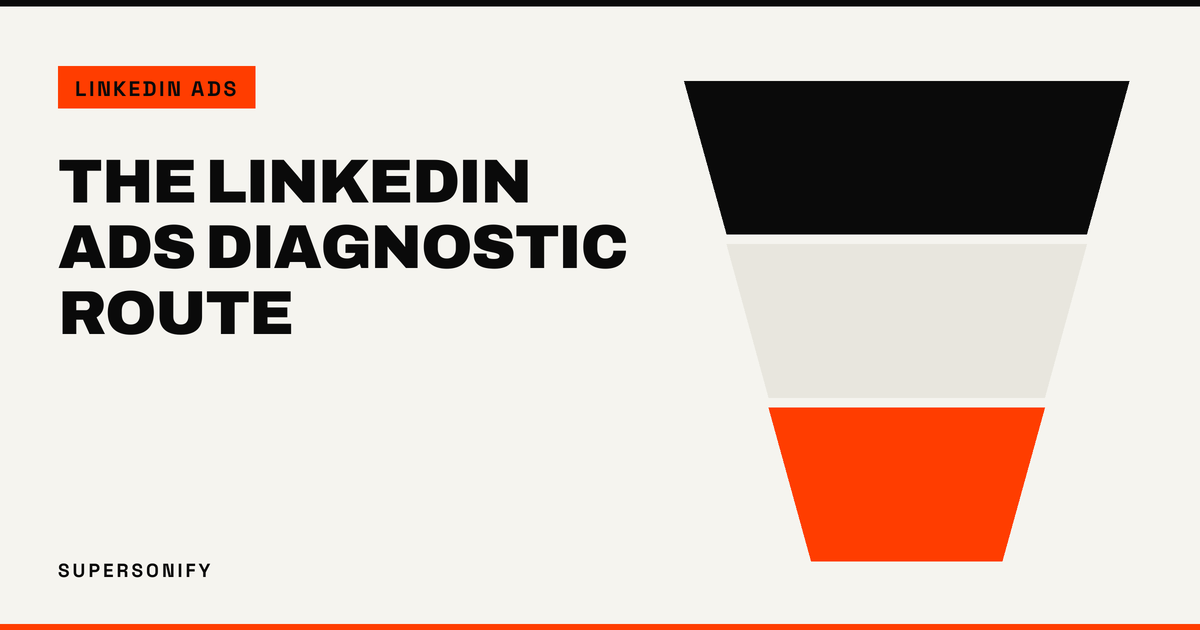
Do not work the list of six causes. Find the broken number first. Check measurement, then delivery, then click-through rate, then conversion rate, then lead quality, in that order, and work only the first gate that fails. Under three impressions per person is a delivery problem. Under 0.4% click-through is a message or match problem. Healthy form fills with an empty calendar is a quality problem, and creative has nothing to do with it.
Find the broken number before you touch a single setting
A campaign that is not converting has exactly one gate failing first, and that gate is the only thing you are allowed to work on this week. Everything else in the account is either fine or unreadable until the first failure is cleared. This is the part the standard six reasons article cannot give you, because a list has no order and a failure does.
The order is fixed for a mechanical reason. Each number in a paid funnel is calculated from the one above it, so a broken number upstream makes every number downstream meaningless rather than merely worse. A click-through rate calculated on 40,000 impressions is a fact. The same rate calculated on 4,000 impressions is a rumour.
say LinkedIn produces leads for them, which means a large minority run the channel and do not get leads out of it. Being in that group is common, and it is usually a routing failure rather than a platform failure.
LinkedIn, 2026Gate one is delivery, and it disqualifies most diagnoses before they start
Two checks, both of which take a minute. First, is the campaign spending close to its daily cap on most days? Second, how many impressions did each person in the audience receive across the flight? Divide total impressions by the forecast audience size to get that second number.
Consistent underspending against the cap means delivery is being constrained rather than chosen. The usual causes are a bid set below what the auction is clearing at, an audience too small to fill the budget, or an ad the system is reluctant to serve. Raise the bid in small steps before you do anything else, because a constrained campaign produces distorted numbers at every gate below.
The impressions per person number is the one nobody calculates. Under three across the flight, the campaign never reached anybody often enough to be recalled, and the click-through rate you are staring at is measuring first sightings by strangers. The fix is to cut the audience, not the creative, and the argument that this reduces opportunity is answered by pointing at the number.
Reducing an audience by geography or seniority lowers the denominator cleanly. Stacking six narrow filters lowers it too, and also raises CPM because the remaining inventory is scarcer and more contested. One or two broad cuts beat six sharp ones.
Gate two is the click, and 0.4% is a triage line rather than a benchmark
With delivery healthy, a click-through rate under 0.4% means the audience you paid to select is declining your message. Treat 0.4% as a routing device, not a verdict. The published click-through benchmarks for LinkedIn disagree with one another by more than the difference you are trying to detect, because they average across formats, countries, seniorities and years that have nothing to do with each other. Replace the line with your own account's trailing median as soon as you have twelve weeks of history.
The useful question at this gate is not how to write a better ad. It is whether the failure is match or message, because the two have opposite fixes and they look identical on a summary screen.
| Test you run | What you hold constant | If the numbers diverge sharply |
|---|---|---|
| Same creative, two audience segments | The creative | It is a match problem, so change who you are talking to |
| Two creatives, same audience segment | The audience | It is a message problem, so change the hook and the first line |
| Both diverge | Nothing | You changed two variables and learned nothing, run them separately |
| Neither diverges and both are low | Everything | The offer category itself is wrong for this channel, which is a bigger conversation |
The discriminator at gate two. Both tests need enough delivery on each variant to be readable, which is why gate one runs first.
Most teams skip the discriminator and rewrite the creative, because rewriting is satisfying and re-targeting an audience feels like admitting the strategy was wrong. The rewrite has roughly a fifty percent chance of addressing the actual cause, which is a coin toss dressed as a decision.
Gate three is the conversion, and low completion is an offer problem
Clicks arriving and leads not arriving means the destination is asking for more than the ad earned. Use 8% click to lead as the triage line for a landing page and treat it the same way as the click gate, as a router rather than a scoreboard. Native lead forms normally run far higher because the fields are prefilled and the friction is close to zero, so never compare the two against a single number.
Split the gate into two measurements before you decide anything. Look at how many sessions start the form, and then how many of those finish it. The two failures point in different directions and the combined conversion rate hides both.
| Form starts | Form completions | What it means | The fix |
|---|---|---|---|
| Low | Not applicable | The page did not repeat the promise the ad made | Put the ad headline and the page headline side by side and make them the same promise |
| High | Low | The ask is too big for the stage the visitor is at | Cut fields, or move the phone number question to the follow-up |
| High | High, few meetings | This is not a gate three failure, it is gate four | Stop editing the page and go tag your last twenty five leads |
| Low | Low, and the page loads slowly on mobile | A share of the traffic never saw the page at all | Check load time on a phone on mobile data, not on office wifi |
Reading gate three properly requires two numbers rather than one.
The single most common finding at this gate is a mismatch between what the ad promised and what the page offers. The ad sells a specific idea, the page sells the company. Lead Gen Forms and landing pages fail differently, and choosing between them is a decision about which failure you would rather diagnose.
- An unordered list of six causes is useless under pressure, because it gives no route and the reader ends up attempting all six at once.
- Gates run in a fixed order and only the first failing gate may be worked, since fixing gate three while gate one is broken burns a quarter and explains nothing.
- Delivery is the gate almost everyone skips, and a campaign under three impressions per person cannot produce a readable click-through rate at any creative quality.
- Published click-through benchmarks for LinkedIn disagree with each other by more than the difference you are trying to detect, so use a triage line to route and your own trailing median to judge.
- Healthy form fills with an empty calendar is a qualification failure, and the diagnosis starts by tagging the last twenty five leads rather than by changing a setting.
Gate four is qualification, where healthy form fills meet an empty calendar
Leads arriving and meetings not arriving is a qualification failure with three possible causes, and you can separate them in twenty minutes without changing a single setting. Pull the last twenty five leads into a spreadsheet and tag each one on two columns: does the job title match your target, and what did they say or not say in reply.
| Pattern in the tags | Cause | Where the fix lives |
|---|---|---|
| Titles are scattered and mostly junior | The offer attracts collectors rather than buyers | Change the offer, not the targeting |
| Titles match, replies are silent | Follow-up is slow or reads like a sequence | Response time and the first message, both outside the ad account |
| Titles match, replies say not right now | Right people, wrong moment | Nothing is broken, add nurture and lengthen the measurement window |
| Titles match but companies are the wrong size | Company size filters are not doing their job | Firmographic filters and an exclusion list |
Reading the tags from your last twenty five leads. The pattern in the two columns names the cause.
Notice that only one of those four rows is fixed inside Campaign Manager. This is why gate four failures survive so long. The dashboard is where people look and the cause is somewhere else, so month after month the creative gets rewritten and the calendar stays empty.
If the tags come back scattered and junior, junk leads have their own cure and it starts with the offer rather than with more filters.
Run the whole route in ten minutes
Pull five numbers in this order and stop at the first one that fails. Do not open the creative until you have all five, because looking at the ads first is what makes people diagnose from taste instead of arithmetic.
Two counts of the same event from two systems. If they disagree by more than a rounding margin, stop here and fix tracking. Everything below inherits the error.
Consistent underspend means constrained delivery. Note it and keep going, but treat every number below as provisional until it clears.
This is impressions per person across the flight. Under three, stop. The audience is too wide for the money and no downstream number can be trusted.
Above it, move on. Below it with healthy delivery, run the match versus message discriminator before writing anything new.
Two numbers, not one. If both are healthy and the calendar is still empty, you are at gate four and the answer is in your CRM, not your ad account.
Ten minutes of this beats a week of creative review, and it also gives you something to say in the meeting that is not an apology. Naming the failing gate turns a vague problem into a specific one with an owner.
A worked example, illustrated rather than real
The following uses invented numbers to show how the route runs. It is an illustration, not a client and not a case study. No result is being claimed for anybody.
A software company spends $4,000 in a month at an assumed $35 CPM, which buys about 114,300 impressions. The audience is 50,000 people. Click-through rate reads 0.31%, giving roughly 354 clicks. The landing page converts 13%, giving 46 leads at about $87 each. Two meetings were booked. The team's instinct is that 0.31% is the problem and the creative needs rewriting.
Run the route instead. Gate zero passes, because the CRM shows 46 leads too. Gate one fails: 114,300 impressions divided by 50,000 people is 2.3 impressions per person, which is under the floor of three. The route stops there. The 0.31% click-through rate is not a message verdict, it is a measurement taken under conditions where most of the audience saw the ad twice at most.
The prescribed change is to cut the audience from 50,000 to roughly 20,000 and keep everything else identical, which lifts impressions per person to about 5.7 on the same budget. That is not a promise that click-through rate will improve. It is the change that makes the next reading of click-through rate mean something, which is the only honest thing anybody can offer at gate one.
The purpose of the route is not to be right about the cause on day one. It is to stop you from spending a quarter answering a question the data was never able to answer.The house position
Three fixes people try first that almost never work
These three appear in nearly every emergency review, and all three fail for the same underlying reason: they change something downstream of the gate that is actually broken.
Rewriting the creative while delivery is failing
New creative resets whatever delivery history the campaign had accumulated and produces a fresh unreadable sample against the same overly wide audience. The team then compares two unreadable samples and picks a winner from noise, which is worse than not testing at all because it produces a confident wrong conclusion.
Adding targeting filters to improve lead quality
Stacking filters shrinks the audience below what the budget needs and raises CPM at the same time, since the remaining inventory is scarcer and more contested. Quality problems that come from the offer are not solved by filters, and the campaign is now both narrower and more expensive.
Switching bid strategy to fix a conversion problem
Bidding controls what you pay for attention. It has no influence on what happens after the click. Changing it when gate three or gate four is failing changes your cost per click and leaves the actual failure exactly where it was, with a new variable now confusing the comparison.
When the ads are fine and the problem is downstream
Sometimes every gate clears and the pipeline still does not move, which means the ad account was never the constraint. Three downstream causes account for most of it, and none of them are visible in Campaign Manager.
- Response time. A lead that waits two days has cooled, and no bidding change recovers it. Assign an owner and an agreed response window before you raise the budget.
- The definition of qualified. If sales and marketing never wrote it down, every review becomes an argument about definitions and the ads lose that argument regardless of what they produced.
- What the buyer finds when they check you out. Attention bought by an ad gets verified against your people and your page, and if there is nothing to find the click was rented rather than earned.
That last one is slower to fix and it is the reason paid and organic are not separate budgets in practice. A written employee advocacy policy is the unglamorous mechanism behind having something for a curious buyer to find, and it costs no media money at all.
None of this excuses a badly run account. It does mean that a campaign passing all five gates and still producing nothing is telling you something true about the business rather than something false about the channel.
Questions people ask next
What click-through rate is normal for LinkedIn ads?
My cost per lead looks good but sales says the leads are useless. What is broken?
Should I pause a LinkedIn campaign that is not converting after one week?
Will new creative fix a low conversion rate on my landing page?
How do I tell a targeting problem from a message problem?
Want this run for you?
Tell us your company and what growth is stuck. A scoped plan with a number in it comes back within 48 hours.
Email the experts →